
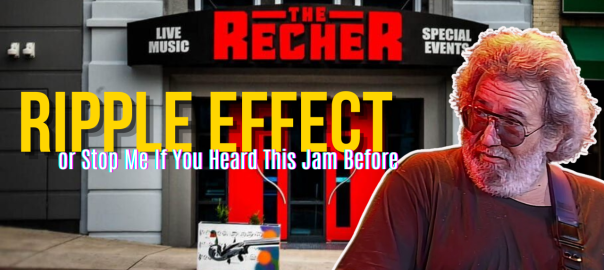
You are at a show. The local Grateful Dead cover band is rocking the house. Then you notice for the last twenty minutes you hadn’t really been listening. Your brain had been vacillating between “Where is the bathroom?” and getting lost in the glow of someone waving the flashlight on their phone like it’s 1979. Both guitarists are staring down at their fingers running the fret baord like they are trying to decipher a hidden truth from the cosmos. The drummer and bassist are locked into the same mid tempo rock groove they have been playing since Clinton was in office. Someone to your right is singing off key and the wrong verse.
Then you have a revelation; ‘I’m done with this.’
Don’t misconstrue it, this isn’t anything against the sacred ground I place the Grateful Dead on. That is something that is vast as continents. There are entire emotional ecosystems that live inside songs like Terrapin Station, Let It Grow and Eyes Of The World; songs so encompassing they map large parts of your life.
The problem is trying to recreate that.
There was a time when seeing Grateful Dead cover bands filled my social calendar. It had ritual, an unpredictable predictability. Every midsize city in America had at least one Dead cover band that has been playing Wednesday nights since before we had dial-up internet. It was as dependable as the sunset when you wanted to check out for a few hours mid work week.
Then at some point gravity shifted.
The musicianship was the first crack in the facade.
Don’t twist it, there are a lot of fantastic players who work their nine to five all week and can replicate Jerry Garcia’s mystic tone. They know it like their own DNA. The runs that pierce like shards of ice. The bastardization of the Bakersfield outlaw country twang. The free jazz sprawl that sounds like a demented saxophone.
On the other side are a lot of bands that are, at best, fine.
Not terrible or mortifying on any level, just fine.
The keyboard is nailing that Brent Myland early eighties slick. The guitar player knows the runs like the back of his hand. The bassist is doing jazz runs over the drummer who does the work of two drummers without derailing the train. They play St Stephen better then the Dead did and can launch Darkstar into a solid fifteen minute voyage through outer space.
But it feels like looking at a picture that was photoshopped.
The Dead were never clean, never perfect. That was the beauty of it, the potential for degeneration into chaos at any moment. Tempos are a suggestion. Everyone solos at once. Jams turn into runaway lawn mowers.
What held it together was their sixth sense.
That is what is so sorely missing with cover bands, you get the skeleton without the flesh. They know where the heart goes in a jam, but there is no blood. It is like watching Bob Ross do paint by numbers.
The room starts to morph. It feels weird.
You go to enough Dead cover band shows and it reads like a formula for a sitcom. There are the guys who think they are still on the lot at RFK in 1989. The couple who slow dance to everything from Ripple to Truckin’. A few college kids getting beer drunk.
And then there are the characters who had run around your life at some point, in a forgotten past.
You know what I’m talking about.
People who you hung out with in high school or college. They shared the same orbit as you because you were both navigating this scene and discovering the same musical worlds. You see them once every few years at best, mostly within the gravitational pull of Dead cover band shows.
A tap on the shoulder. An awkward hug.
“Hey MAN! It’s been years!”
You pull up the card catalog of memory, try to put a face to a name. There are fragments of a conversation, but it is a time or place lost to alcohol or LSD.
Now comes the small talk.
“What are you up to?”
“You still (arbitrary activity)?”
“How is (person you think you both know)?”
The band is still chugging on, roaring through a 3rd reprise of Viola Lee Blues. You are nodding “That’s crazy” for the twelfth time and mapping out how to get to the front door so you can grab a smoke.
Small talk is the worst kind of improvisation because no one says anything. A lot of “I’ve been busy,” and “Things are good.” Maybe a mention of a job or kid or big move coming up.
Searching for some connection in the memory of a dream you once shared.
The moment you realize you are no longer part of that tribe.
At one time Dead culture was a secret handshake. You would be walking through the mall and see someone with a Steal Your Face shirt and you would knowingly nod. You knew they were your people without saying a word. It was an underground community.
But you can’t stay underground forever.
There is distance as you stand there watching the band launch into Bertha for the four millionth time. The spark you felt before is gone, recognition without joy. As if you are suddenly back in high school. The hallways are the same, the smells, the whirl of bodies in motion, but the emotional nervous system is gone. There is a void. What these walls are remembering doesn’t exist anymore.
Maybe it is recapitulation on some level.
The Grateful Dead’s catalog demands endless reexamination. They did it every night for thirty years because they always believed the magic depended on it. They could take you to the deepest reaches of the galaxy and land you gently as you please on the other side.
This is a Herculean task for any band, let alone a cover band. The unpredictable element is what suffers. The songs can feel lived in, but without being there when they were built you don’t know what is behind the walls.
You can write the set list driving to the show. A big opener, a few shorter warm ups, a big jam or two to close the first set. Second set you get the jam vehicles, a Dark Star or Playing In The Band, maybe even a Terrapin Station if they are feeling themselves.
Time is frozen. The music and the audience.
1980s Deadhead culture is in full force. People don their uniforms and the room becomes a museum full or tie dye, patchouli, and Birkenstock. If it only felt alive instead of like a historical reenactment.
Evolution is all that maters ultimately, constant mutation and bringing in new styles like the Grateful Dead did. When they failed it was still interesting because they were pushing the envelope.
A cover band by definition does the opposite, capturing a band in a place and time.
That is nostalgia impersonating investigation and as you get older nostalgia starts to seem strange. No longer does it serve as a safe corner where your memory is of consequence or searches for comfort that the music that made you still existed in the wild.
The corner becomes suffocating.
The room is full of chatter on an endless loop. “Best show ever,” “favorite Franklin’s Tower,” mushrooms or acid, who made the best grilled cheese on lot.
But you are far from that anonymous hockey arena’s parking lot.
You have found other parking lots and sometimes just silence.
You outgrow things, not because there is anything wrong with it, but because you got everything you needed from it.
Last night the band started a stirring version of Brokedown Palace late in the night. Everyone drifted side to side in unison. People whispered the lyrics in quiet reverence.
I stood there watching, an observer in a church that was no longer mine.
I love that song, it can bring a tear to my eye, but the feeling I remember sharing that deep connection with everyone in the room had quietly expired.
The music was what I loved, but here it became background noise to a social ritual that was no longer mine.
I am mourning a community that helped me become who I am, that was home, but now seemed like a place that wasn’t even comfortable to come back to. All the people I used to be fill the room, you can hear the small talk and debates echo.
And the music doesn’t stop.
The band launches into another rave up. Someone spills a drink. I go outside to grab a smoke.
It’s not that anything is inherently wrong in the moment, just my inner compass is telling me my North star is somewhere else. There is no anger at the band or judgment of the people who still find salvation here. I love that they still have that, alive inside something that meant everything to me once.
The band played one more song as the clock approached midnight. The crowd move in closer to the stage to bask in the glow one last time tonight.
And maybe that is all that matters. The music exists for the people who need it. Sometimes I am sure I still will, but for now I’ll just slip out the side door. It’s like hopping off a carousel and leaving the gold ring for the next person.
In a few weeks they will play again.
I am OK with missing it.
 Inertia Satori