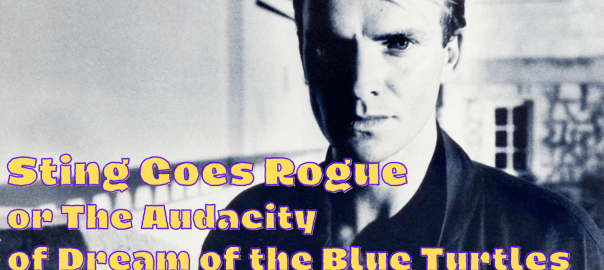
It takes guts to walk away from the biggest band in the world. It takes defiance to then make an album that seemed designed to confuse everyone from the record company to the critics to the fans. That is exactly what Sting did in 1985. On his solo debut, “The Dream Of The Blue Turtles,” he made a statement of intent that was equal parts refusal and provocation.
Looking back it was a fascinating gamble. There was no easing into a post-Police identity, no transitional record, no pussyfooting. He followed his instinct and assembled a band of jazz assassins to make, what is at first listen, a pop record that revealed so much more just below the surface.
The opener, “If You Love Somebody Set Them Free,” is pure pop poetry, bright and bouncy, with a great hook, but listen closer. Lyrically it is a clean break from the possessive paranoia of “Every Breath You Take.” Musically, the rhythm doesn’t sit still, the groove breathes and flexes; the band orbits each other refusing to lock into place. This made the critics and record company uneasy because it was too slick for jazz and too fidgety for pop. They were all shouting, “What is this album supposed to be?”
Sting doesn’t give an easy answer, and ultimately just pushed a answer further away the deeper you get into the album.
“Russians” barely qualifies as a song in the pop sense. It is piercing, frozen in the Cold war, set to a borrowed piece of classical music and delivered with unflinching seriousness. The words pleading for common humanity, something so simple that at the time was seen as radical. The critics again were flinching at what seemed like gravitas coming from the pop reggae guy.
“Russians” is followed by “Children’s Crusade,” and the jazz ambitions are front and center. It asks a lot; dense, intricate, rich chords and an open structure. It’s heavy and doesn’t offer the listener an immediate reward, requiring instead engagement. The critics hated it because it didn’t distill it’s subject matter into a neat digestible slogan.
But it isn’t all like that, toward the end of side two we get “Moon Over Bourbon Street,” which gives us resolve and clarity for everything that came before. It is moody like a lot of the album. Narrative driven and atmospheric, the music serves the story instead of vice-a-versa. Branford Marsalis sax paints the edges, almost haunting them and you are carried away on the melody before being pulled in by the lyric. It all make sense now, Sting’s ambition coming through and the sense that he can inhabit many world’s at once.
He had built something at the intersection of rock and jazz that wasn’t quite the solo album anyone expected. In 1985 this was unheard of; jazz phrasing, pop hooks, and a political conscious with no critical framework. The critics said “Pick a lane,” Sting built an overpass.
And there is your disconnect: the record companies wanted continuity, the ‘new’ Police, critics wanted him all in or all out of the jazz tradition. What the fans embraced was an artist in transition: experimenting, overreaching, occasionally borrowing, but moving toward something new.
The fans were all that mattered in the end. The album sold millions and the songs have endured. The questions about genre and identity have been washed away. Sting could lead a virtuoso band, blur boundaries and still hit the pop charts.
We had the privilage of watching an artist morph into his next stage. That’s why “The Dream of the Blue Turtles” still holds it’s own where a Police rip off probably wouldn’t.
 Inertia Satori