Tag Archives: poem

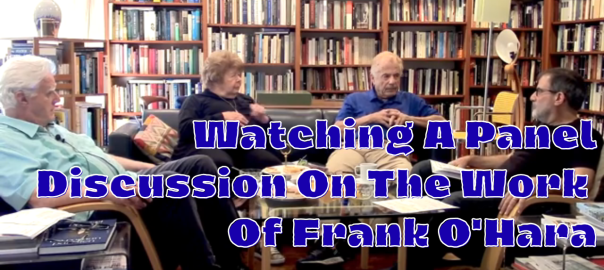
Watching A Panel Discussion On The Work Of Frank O’Hara

Frank O’Hara thought he was a funny guy. He did this, then he did that, and he told you about it. Now we have panels dissecting each word as if his poems were dead; a post mortem where they declare today is devoid of such brilliance. They don’t realize poetry is not dead, it’s just not in their classrooms and textbooks.

There seems to be a disconnect and I think it starts with a faulty supposition, the notion creation of a poem is Idea> Artist> Text. Here, the artist is expressing or reproducing systems and the material text is almost a byproduct. From a small sample size of poets, me, I find this so off-base. Any idea I sit down with is quickly hi-jacked by the storm of thought and feeling that force themselves into language once I put pen to paper. The process should be framed Artist> Text> Idea. Here, meaning through making, not before, the medium – word, sound, form – shapes thought.

Frank was gay, the critics and academics make sure every word he wrote reflects that. They tell using fifty cent words that roll out like a jingle of jumble and jargon. They don’t see, poems should be, just be, fill space between the first cup of coffee and the long walk back up stairs to get dressed for another day at what you call ‘job.’ Don’t pay attention when the voices from the university shout “You missed the point” because you didn’t look at it the right way.

I like Frank, have since I first read him in the mid eighties. Today I learned he was gay. Does it change ‘having a coke with you’ if the speaker is speaking to another man? No, I still love it for the tone, the rhythm, the power of new love it captures. Do I read it differently? No, because my purpose as a reader is to allow myself to feel, to frame those words through the lens of my own experience. It teaches me I am not alone, that others have felt what I do and through image manifested in language take me back to personal experience.

Perhaps the critics and the academics need to come out of the mildewy halls of university that are draped with wrath, where whispers are overheard of the poet being dead, and step into the light. Close their eyes and listen, understanding is optional. They should get back to the basics, get lost in the image, bathe in the rhythm and and let the prosody swell in their loins. Touch that cold dark place where wonder once swelled at the word. Shot out of a cannon into the continuum. Poems live in that liminal space and let you commune with god.

The Poetry-Industrial Complex: Who Decides What Poetry Is?

You can hear it in barrooms and coffee shops, that old gripe that poetry is run by gatekeepers. The real stuff, the guttural, late night truth, doesn’t live in magazines of MFA workshops. It lives on the street, in the unfiltered voices whose rhythm is a jackhammer that reveals diamonds.

And they would be right.

There is a strange little ecosystem, a poetry-industrial complex so to speak. It is made of small magazines, university presses, and workshop networks. It follows fashion and rewards proximity.

The right editor at the right reading and you might get the nod. That old cliché about who you know has become the invisible submission guide. If you want recognition, and who doesn’t, this is the sanctioned road, the tried true way of carefully crafted, worked over until nothing unpredictable survives poetry forged in workshops. It can be electric, but it is more often than not so well behaved it loses its truth.

Academia asks the poet to translate them self into something publishable, full of language theory, perfect iambs and workshop norms.

But there is another side, another scene, like the pirate station you can find if you turn the dial just a little and let the static bleed. It is the poems that spill out from the feedback of an open mic night on a half broken PA. It is the words that fill the backs of junk mail and little notebooks walking home from a 10 hour shift.

These verses don’t care if they’re publishable. They stick like a song you can’t shake. Think Patti Smith with three chords and a confession that hits like a sledgehammer, or Gil Scott-Heron detonating thought bombs mid-line.

The poetry that refuses to ask permission to exist. The defiant poetry that shows up and dares you to look away.

The problem is that no one sees these poems. The system that decides who gets published also works as a system to filter voices. The record kept is incomplete, magazines are archives of what a small insulated group thinks is poetry. People who I am sure are trying to, imperfectly, make sense of what matters, but only hear echoes.

Not making this into some mustache twirling villain situation. It is just the system doing what it does, narrowing. That is where the tension swirls, somewhere between saying what matters and having the poem be something that might last.

You end up with a disconnect. Poets smoothing the edges of their voice to get in the door or refusing to compromise and risk their voice being unheard.

Poetry isn’t owned by magazines or collected anthologies of the ‘best new poets,’ but magazines do act like a style book defining what is considered a poem at the current moment. The real stuff, the messy, unrepeatable, blood and sweat poetry happens elsewhere, off the page.

If you listen close, somewhere between a whisper and a scream, you can hear it, where nobody’s asking for credentials to have your voice heard.